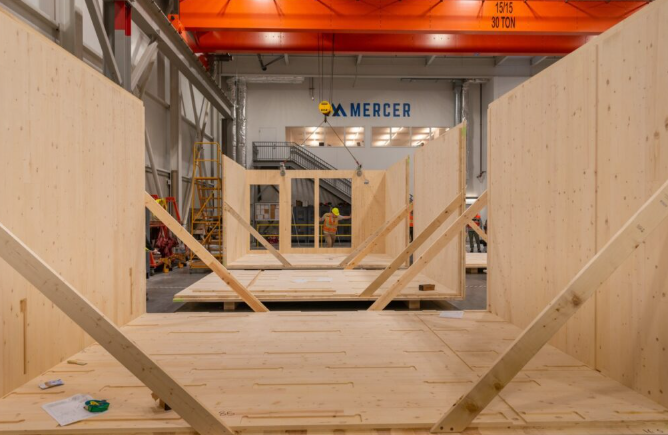
Something significant is happening in the way buildings are being constructed across the United States. Mass timber — a category of engineered wood products that includes cross-laminated timber, glued laminated beams, nail-laminated timber, and dowel-laminated timber panels — is moving rapidly from a niche architectural choice to a mainstream structural system. Office buildings, apartment towers, schools, hotels, and mixed-use developments are all being built with mass timber in cities and towns across the country, and the pace of adoption is accelerating.
For contractors and lumber suppliers, this shift is not just an interesting industry trend to follow from a distance. It is a direct business opportunity — and in some markets, it is becoming a competitive necessity. Understanding what mass timber is, why it is growing so quickly, and what it means for how you operate your business right now is essential for anyone serious about staying relevant in U.S. construction over the coming years.
What Is Mass Timber and Why Is It Different
Mass timber refers to a family of engineered wood products made by bonding together layers, pieces, or strands of wood under pressure to create large structural panels, beams, columns, and floor systems. Unlike traditional dimensional lumber — which is limited in size and structural capacity by the trees it comes from — mass timber products are engineered to specific performance standards and can be manufactured in sizes and configurations that rival steel and concrete in structural applications.
The most widely used mass timber product is cross-laminated timber, or CLT. CLT panels are made by stacking layers of dimensional lumber in alternating directions and bonding them together. The result is a large, flat structural panel that can be used for floors, walls, and roofs. CLT is strong, dimensionally stable, and surprisingly fire-resistant — contrary to what many people assume, thick mass timber chars on the outside when exposed to fire, which actually protects the structural core and allows mass timber buildings to meet demanding fire safety codes.
Glued laminated timber, or glulam, has been used in construction for decades but is now being specified in new applications as mass timber construction becomes more mainstream. Glulam beams and columns provide the long-span, high-load structural capacity needed for the types of large, open-floor-plan buildings that are popular with commercial and residential developers today.
Newer products like nail-laminated timber and dowel-laminated timber panels are also finding their way into projects, particularly for floor systems and wall panels. Each of these products has specific performance characteristics, cost profiles, and fabrication requirements that contractors and suppliers need to understand when evaluating projects and preparing bids.
See also: How Medical Spas Treat “Tech Neck” Lines And Crepey Skin
Why Mass Timber Is Growing So Quickly Right Now
Several forces are converging to drive the rapid growth of mass timber construction in the United States, and understanding them helps explain why this trend has real staying power rather than being just a passing architectural fashion.
Building codes have changed significantly in recent years. Updated model codes now allow mass timber buildings to reach heights of up to 18 stories in some configurations, up from previous limits that restricted wood construction to much lower buildings. This code change opened up a vast new range of project types — mid-rise residential, commercial office, and mixed-use developments — that were previously off-limits for wood structural systems. Developers and architects who had been watching mass timber with interest but waiting for code clarity now have the regulatory framework they need to move forward.
Sustainability is another major driver. The construction industry is under increasing pressure — from clients, investors, regulators, and the public — to reduce its environmental footprint. Mass timber has a compelling sustainability story. Wood is a renewable resource. Manufacturing mass timber products requires significantly less energy than producing steel or concrete. And wood products store carbon rather than emitting it, giving mass timber buildings a favorable life-cycle carbon profile compared to conventional structural systems. For developers pursuing green building certifications and sustainability commitments, mass timber is an attractive option.
Speed of construction is also a factor. Mass timber components are precision-fabricated in factories and arrive on site ready to assemble. A well-coordinated mass timber project can progress much faster than a comparable cast-in-place concrete building, reducing construction schedules and the financing costs that come with them. Developers with tight pro formas and lenders who care about construction timeline risk are paying close attention to these schedule advantages.
Finally, aesthetics play a real role. Mass timber buildings look and feel different from steel and concrete structures. The exposed wood surfaces create warm, natural interiors that tenants and buyers respond to positively. In a competitive real estate market, this aesthetic differentiation can translate directly into higher rents and faster absorption — which is why commercial office developers, hospitality brands, and multifamily residential developers are all showing strong interest in mass timber.
What This Means for Lumber Suppliers
The mass timber trend is creating both direct and indirect opportunities for lumber suppliers across the country, but capturing those opportunities requires understanding how the supply chain works and where the value is.
Mass timber products themselves — CLT panels, glulam beams, and other engineered wood components — are manufactured by a relatively small number of specialized producers. Most of these facilities are located in the Pacific Northwest, the Mountain West, and parts of the Southeast, where access to softwood timber resources is strong. For lumber suppliers who are not in the manufacturing business, the direct opportunity to supply raw lumber into mass timber production is real but concentrated among those with the right geographic position and scale.
However, the indirect opportunities are significant and more broadly accessible. Every mass timber building also uses large quantities of conventional lumber and engineered wood products — for blocking, furring, interior framing, exterior wall systems, and a wide range of secondary structural and finish applications. Suppliers who serve contractors building mass timber projects will see these complementary material needs alongside the mass timber components themselves.
There is also a growing market for mass timber components as suppliers expand their product lines to include CLT and glulam. Regional lumber dealers and building material distributors in active construction markets are beginning to stock or special-order mass timber products in response to contractor demand. Getting ahead of this curve — developing relationships with mass timber manufacturers, understanding lead times, and building the knowledge base to serve contractor customers effectively — is a smart investment for forward-thinking suppliers.
For suppliers supporting framing contractors on mass timber-adjacent projects, having a clear picture of the complementary wood framing scope is essential for competitive and accurate quoting. Contractors who use professional lumber takeoff services on these projects are able to give their suppliers precise, itemized material lists that allow for accurate pricing and reliable delivery scheduling — reducing the back-and-forth that slows down the procurement process and increases the risk of delivery errors on complex jobs.
Opportunities and Challenges for Contractors
For contractors, mass timber construction represents a genuine opportunity to diversify into a growing market segment — but it also requires real investment in knowledge, skills, and relationships.
The construction process for a mass timber building is different from conventional steel or concrete construction in important ways. Mass timber components are fabricated to precise tolerances using digital design files, which means the quality and accuracy of the design documentation must be exceptionally high before fabrication begins. Changes during construction are costly and time-consuming because components are manufactured to specific dimensions and cannot easily be modified on site.
This places a premium on pre-construction coordination. Contractors who are experienced in design-assist and design-build delivery methods — where the contractor is involved in the design process early — are better suited to mass timber work than those whose experience is limited to traditional design-bid-build projects. Getting involved early, asking the right questions about shop drawing coordination, connection design, and erection sequencing, and building strong working relationships with the mass timber manufacturer are all critical success factors.
Erection and installation of mass timber requires specialized knowledge. Large CLT panels and glulam members need to be lifted with appropriate rigging, set with precision, and temporarily braced correctly while permanent connections are made. Contractors who have not previously worked with these materials should invest in training and, where possible, bring in experienced personnel or subcontractors for their first few projects.
On the estimating side, mass timber projects require careful attention to the interface between mass timber structural scope and the complementary wood framing, blocking, and finish carpentry work. The structural mass timber components themselves are typically supplied and sometimes erected by the manufacturer, but everything else is the contractor’s responsibility — and the boundaries of that scope need to be clearly understood before a bid is submitted.
How Accurate Quantity Measurement Protects Contractors on Mass Timber Projects
Because mass timber projects combine several different scopes — structural mass timber components, conventional wood framing, sheathing, blocking, and finish carpentry — the estimating process is more complex than on a straightforward wood-frame residential project. Getting each piece of the scope right requires a systematic, detailed approach to quantity measurement that does not rely on shortcuts or assumptions.
The structural mass timber components are typically quoted directly from manufacturer pricing, which is based on detailed shop drawings. But the complementary framing, blocking, and miscellaneous wood scope needs to be taken off from the architectural and structural drawings — and this work is often more extensive than it first appears. Exterior wall framing, interior partition framing, blocking for attachment of mechanical and electrical systems, and miscellaneous support structures all add up quickly and need to be counted carefully.
Contractors who invest in precise quantity measurement for the wood framing scope on mass timber projects are consistently better positioned on bid day. Working with professional wood framing takeoff services for the conventional framing portions of a mass timber project gives estimators confidence that the complementary scope is fully captured — so the bid reflects the true cost of the work rather than an optimistic estimate that will create margin problems during execution.
Accurate takeoffs also help contractors have more productive conversations with their lumber suppliers about exactly what materials are needed, in what quantities, and on what schedule. On a mass timber project where the structural elements have long lead times and the project schedule is tight, having a clear and reliable material plan for the complementary framing scope is essential for keeping the job moving.
Regional Markets Leading the Mass Timber Boom
Mass timber construction is not evenly distributed across the country. Certain regional markets are significantly more active than others, driven by a combination of regulatory environment, developer appetite, design culture, and proximity to mass timber manufacturing.
The Pacific Northwest — Oregon and Washington in particular — has been the most active market for mass timber construction in the United States. This is partly due to the region’s strong connection to the forest products industry and partly due to a design and development culture that has embraced sustainable building practices earlier and more enthusiastically than most other regions. Portland and Seattle have a higher concentration of completed mass timber buildings than any other U.S. cities, and the pipeline of projects under design and construction continues to grow.
Colorado and other Mountain West states are also seeing strong mass timber activity. The combination of a sustainability-oriented development culture, strong population growth, and active commercial and residential markets is creating significant demand. Several large mass timber projects — office buildings, hospitality properties, and multi-family residential developments — have been completed or are underway in Denver and other Front Range cities.
The Southeast is emerging as a growth market. States like Georgia, North Carolina, and Tennessee have active construction markets, growing populations, and a strong wood products industry heritage that makes mass timber a natural fit. The availability of domestically grown Southern Yellow Pine and other hardwoods as potential feedstocks for mass timber production is drawing attention from manufacturers looking to expand their footprint.
Even in markets where mass timber has not yet gained a strong foothold, contractors and suppliers who start building knowledge and relationships now will be better positioned when the market develops. Mass timber is not a regional trend — it is a national one that is gradually extending into every major construction market in the country.
Building Your Business Around the Mass Timber Opportunity
For contractors and suppliers who want to position themselves to capture a share of the growing mass timber market, the path forward requires deliberate investment in a few key areas.
Education is the starting point. Understanding how mass timber products are manufactured, specified, and detailed — and how this affects the construction process — is foundational knowledge that every contractor and supplier who wants to work in this space needs to develop. Organizations like the American Institute of Timber Construction, WoodWorks, and the Softwood Lumber Board publish technical resources and offer training programs that are highly practical and accessible.
Relationship building is the next step. The mass timber supply chain is still relatively concentrated, with a limited number of manufacturers producing the core structural products. Building direct relationships with these manufacturers — understanding their lead times, their quoting processes, and their technical support capabilities — is valuable for both contractors and distributors who want to serve this market.
For contractors, pursuing early involvement in design processes is a key strategy. Mass timber projects benefit enormously from contractor input during design, particularly around constructability, sequencing, and cost management. Contractors who position themselves as knowledgeable partners in the design process — rather than simply bid responders — are more likely to win work and build the kind of repeat client relationships that create a stable project pipeline.
For suppliers, investing in product knowledge and inventory planning for mass timber-adjacent materials is a practical and relatively low-risk way to build capability in this market. Stocking the complementary materials that mass timber projects need — specialized fasteners, structural connectors, fire-treated blocking, and high-performance sheathing systems — and having the expertise to help contractor customers specify them correctly creates real value that goes beyond commodity lumber sales.
The Longer View on Mass Timber and Wood Construction
Mass timber is part of a broader shift in how the construction industry thinks about wood as a structural material. For most of the past century, wood construction in the United States was largely limited to low-rise residential buildings. Steel and concrete dominated commercial and mid-rise construction, and this division of the market seemed permanent. Mass timber is challenging that assumption in a fundamental way.
As more buildings are completed and the performance record of mass timber in real-world conditions continues to accumulate, confidence in the system will grow. Insurance underwriters are becoming more comfortable with mass timber risks. Building officials are becoming more familiar with the code requirements. And the pool of contractors and suppliers with mass timber experience is expanding steadily.
The businesses that invest in building that experience now — while the market is still in its growth phase — will have a competitive advantage as the market matures and the volume of work increases. Early movers in growing market segments typically capture a disproportionate share of the value as the market develops, and mass timber construction in the United States is a growing market segment in every meaningful sense of that term.
Final Thoughts
Mass timber construction is reshaping the landscape of U.S. building in ways that create genuine, lasting opportunities for contractors and lumber suppliers who are willing to invest in understanding and serving this market. The structural code changes are in place. The sustainability demand is real. The developer interest is strong. And the supply chain, while still developing, is growing to meet the demand.
Whether you are a framing contractor looking to move into new project types, a lumber supplier exploring product line expansion, or a general contractor evaluating whether to pursue your first mass timber project, the fundamentals of success are the same: build knowledge, build relationships, and build systems that allow you to estimate, procure, and execute with precision. The mass timber market is open and growing. The opportunity is there for those prepared to take it.