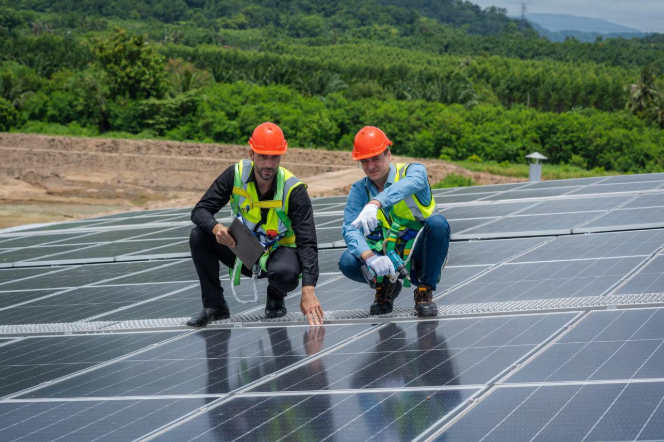
Across the United States, large-scale solar farms, battery energy storage facilities, and utility-scale wind projects are being developed at a pace that has few historical comparisons. Hundreds of projects are in various stages of permitting, design, and active construction in states from California and Texas to the Carolinas, Ohio, and beyond. The land clearing, grading, drainage, and civil work required to bring these projects to life represents one of the largest and fastest-growing segments of earthwork and civil contracting in the country right now.
For earthwork contractors, civil subcontractors, and the material suppliers who serve them, this wave of energy project construction is creating genuine and substantial business opportunities. But capturing those opportunities requires understanding how these projects work, what makes them different from traditional commercial or residential site work, and what it takes to bid and execute them successfully. The contractors and suppliers who get educated early and build the right capabilities will be well-positioned to grow their businesses significantly in the coming years.
Why Utility-Scale Energy Construction Is Exploding Right Now
Several major forces are driving the surge in utility-scale energy project construction across the United States, and together they are creating a demand environment that is unlikely to reverse anytime soon.
Electricity demand in the United States is growing again after years of relative flatness. The rapid expansion of data centers — driven by cloud computing and artificial intelligence infrastructure — is placing enormous new loads on the grid in regions across the country. Electric vehicle adoption is also increasing electricity consumption. Industrial reshoring, with new manufacturing facilities being built in domestic markets, adds further load. Grid operators and utilities are responding by aggressively contracting for new generation capacity, and solar and storage are winning the vast majority of those contracts because of their competitive cost profiles and relatively fast construction timelines compared to other generation types.
Federal incentive structures have also been a powerful accelerator. Tax credits for clean energy generation and storage are available at levels that make projects financially attractive to developers and investors, and a substantial portion of the project pipeline that has been built up in recent years is now actively moving into construction. The development side of the industry has spent years preparing these projects — acquiring land, securing interconnection agreements, obtaining permits — and many of those efforts are now translating into active construction contracts.
State-level renewable energy mandates are adding another layer of demand. Many states have established requirements for utilities to source specific percentages of their power from renewable sources by defined target dates, and utilities are responding by contracting for large volumes of new solar and wind generation. This policy-driven demand creates a reliable, long-term project pipeline that contractors and suppliers can count on for years into the future.
See also: How Medical Spas Treat “Tech Neck” Lines And Crepey Skin
What the Civil and Earthwork Scope Looks Like on a Solar Project
For earthwork contractors who have not previously worked on utility-scale solar projects, understanding the scope of civil and grading work involved is the first step toward evaluating whether this market is the right fit for your business.
A typical utility-scale solar project occupies hundreds or even thousands of acres. Before a single solar panel can be installed, the entire site needs to be cleared of vegetation, grubbed to remove root systems, rough-graded to establish design grades, and finished-graded to the precise tolerances required for the solar mounting systems. Drainage systems — swales, retention basins, underground storm drainage pipes and structures — need to be designed and constructed to manage stormwater across the entire project footprint. Access roads connecting different parts of the project need to be built, typically with a gravel or aggregate surface capable of supporting heavy construction and maintenance equipment.
The grading work on solar projects has specific requirements that differ from conventional site development. Solar panel mounting systems — whether ground-mounted fixed-tilt racking or single-axis trackers — require consistent, precise finished grades across large areas. Uneven grades create shading issues between rows of panels and can cause problems with the structural performance of the racking systems. Getting the grading right requires careful planning, accurate grade control technology, and experienced operators who understand the tolerance requirements.
Cut and fill calculations on large solar sites can be extremely complex. Site designers work to minimize the total earthmoving volume by optimizing grades across the entire project footprint, but on sites with significant topographic variation, the cut and fill quantities can be very large. Balancing cut and fill — minimizing the amount of material that needs to be imported or exported — is a critical cost management objective, and errors in earthwork quantity calculations at the bid stage can translate into enormous cost overruns during construction.
Underground utility work — electrical conduit and cable systems connecting the inverter stations, substation, and individual solar panel strings — also requires significant trenching and backfill work. On a large solar project, the total linear footage of underground conduit can run into tens of thousands of feet, and this trenching scope needs to be accurately captured in the bid.
How Bidding Solar and Energy Projects Differs From Traditional Site Work
Contractors who come to utility-scale solar projects from a background in traditional land development or commercial site work will find both familiar elements and important differences in how these projects are bid and contracted.
Project scale is the most obvious difference. A large solar project can involve more total earthwork volume than many contractors will complete in an entire year of conventional site work. This scale creates real opportunities but also real risks — a significant error in the bid on a project of this size can be financially catastrophic, and project owners typically hold contractors to fixed-price contracts with limited opportunities to recover unanticipated costs.
The project owner and contracting structure is also different from typical commercial development work. Utility-scale energy projects are typically developed by specialized renewable energy developers, who then sell or transfer the projects to long-term owners — utilities, infrastructure funds, or corporate energy buyers. The contracts used in this industry are specialized documents that often include specific performance guarantees, liquidated damages provisions, and warranty obligations that are more demanding than typical commercial site work agreements. Contractors who are not experienced with these contract structures should review them carefully with legal counsel before signing.
Quantity accuracy is absolutely critical on solar site bids. The grading and earthwork scope on a large solar project can represent millions of dollars of cost, and even a small percentage error in the earthwork quantities can translate into significant financial loss on a fixed-price contract. Many experienced civil contractors in this space rely on professional earthwork estimating services to ensure that their cut, fill, stripping, and import/export quantities are precisely calculated from the design drawings before any pricing is applied. The investment in accurate quantity measurement is small compared to the financial risk of entering a large fixed-price contract with incorrect earthwork numbers.
Scheduling is another area where solar projects differ from conventional site work. Solar developers and their investors work to very tight project schedules, driven by interconnection agreements, tax credit qualification deadlines, and power purchase agreement commencement dates. Delays in construction can have significant financial consequences for the project, and contractors who cannot meet schedule requirements will face penalties and damage to their reputation in what is a relatively close-knit industry where word travels fast.
Equipment and Resource Requirements for Large Energy Project Earthwork
Successfully executing earthwork on a large solar project requires significant equipment resources. The volumes of material involved — sometimes hundreds of thousands or even millions of cubic yards of grading — require large fleets of scrapers, dozers, motor graders, and compaction equipment. Projects in remote locations may require mobilizing this equipment over long distances, which adds cost and logistical complexity.
Grade control technology is essentially mandatory on solar site grading work. GPS-guided machine control systems allow equipment operators to achieve the precise finished grades required for solar mounting systems efficiently and consistently. Contractors who do not have this technology — or who do not have operators experienced in using it — will struggle to meet the grade tolerance requirements and will be at a significant productivity disadvantage compared to competitors who do.
Water management during construction is also a critical operational consideration. Large clearing and grading operations on multi-hundred-acre sites generate significant erosion and sediment control obligations under state and federal stormwater permits. Erosion control installations — silt fences, sediment basins, check dams, and hydroseeding — need to be planned and resourced carefully. Permit violations on energy projects attract regulatory attention and can result in stop-work orders that are extremely costly given the tight project schedules involved.
Labor requirements on large energy project sites are substantial. Superintendents, grade checkers, equipment operators, laborers, and quality control personnel all need to be mobilized and managed. In markets where skilled construction labor is in short supply — which describes most active U.S. construction markets right now — having strong workforce relationships and recruitment pipelines is a genuine competitive advantage for contractors pursuing this work.
Opportunities for Aggregate and Civil Material Suppliers
The boom in utility-scale energy project construction is creating significant and sustained demand for aggregate materials, erosion control products, geotextiles, drainage pipe, and a wide range of other civil construction materials. Suppliers who are positioned to serve this market efficiently can build strong, recurring revenue streams as the project pipeline continues to develop.
Aggregate demand is particularly large. Access road construction, drainage layer gravel, trench backfill aggregate, and substation pad construction all require large volumes of crushed stone, gravel, and sand. On a major solar project, aggregate consumption can run into tens of thousands of tons. Suppliers with quarries or distribution facilities near active solar development regions have a significant logistics advantage, and developing direct relationships with the general contractors and earthwork subcontractors active in this space is a high-value business development activity.
Erosion control and stormwater management products — geotextile fabrics, silt fence, erosion control blankets, sediment filter tubes, and riprap — are consumed in large quantities on solar sites due to the large areas of disturbed soil involved. Suppliers of these products who understand the stormwater permit requirements that govern solar construction and can provide technical support to contractors navigating those requirements will find receptive customers who value that expertise.
Underground drainage pipe — corrugated metal pipe, HDPE pipe, concrete pipe — and associated structures are needed for the internal drainage systems of solar projects. Precast concrete catch basins, headwalls, and junction boxes are standard components on most projects. Suppliers who can deliver these products reliably and with reasonable lead times to project sites in various locations have a strong value proposition for contractors managing tight construction schedules.
For suppliers considering how to position themselves in this market, proximity to the project pipeline is worth thinking about strategically. Solar development activity is concentrated in certain regions — the Sun Belt states, Texas, the Midwest, and the Southeast — and suppliers in or near these regions have natural advantages. Understanding where active development is happening and aligning your sales and logistics resources accordingly is a practical first step toward capturing market share.
Managing Risk on Large-Scale Energy Earthwork Contracts
The financial scale of utility-scale energy earthwork contracts means that risk management deserves serious, systematic attention from contractors pursuing this work. Several categories of risk are particularly important to understand and manage.
Subsurface conditions are one of the most significant sources of risk on any earthwork project, and solar sites are no exception. Unexpected rock, soft soil conditions, buried debris, or high groundwater can dramatically increase the cost and difficulty of grading and drainage work. Thorough geotechnical investigation — and careful review of the geotechnical reports provided in the bid documents — is essential before committing to a fixed price. Contractors should also review contract language carefully to understand whether the owner provides any representations about subsurface conditions and what remedies are available if conditions differ materially from what was anticipated.
Weather risk is also significant on large outdoor earthwork projects. Extended periods of wet weather can halt grading operations completely, and making up lost time on a tight schedule often requires additional equipment and overtime costs. Understanding the typical weather patterns in the project location, building appropriate weather contingencies into the schedule, and reviewing contract provisions for weather-related schedule relief are all important pre-bid activities.
Scope definition risk is a less obvious but equally important category. Solar project designs often continue to evolve during the construction period as equipment specifications are finalized, interconnection requirements are updated, or owner decisions about project configuration change. Contractors need to understand clearly what scope is included in their contract, how changes will be documented and priced, and what approval processes govern changes to the contracted scope. Ambiguous scope boundaries on a project of this scale can lead to significant disputes that are difficult and costly to resolve.
Getting Your Business Ready to Compete in This Market
For earthwork contractors and civil suppliers who are not currently active in the utility-scale energy market but want to pursue it, building readiness is a process that benefits from a structured approach.
Start with market intelligence. Understand which developers are active in your region, what projects are in the development pipeline, and when those projects are expected to move to construction. Sources like industry databases, state permitting agencies, utility interconnection queues, and trade publications can provide valuable information about the pipeline of work that is coming to bid in your area. Identifying the general contractors and project developers who will be issuing bid packages for civil and earthwork scope gives you a target list for relationship development.
Assess your equipment and capacity honestly. Can your current fleet handle the scale of work that is typical for utility-scale solar? Do you have or can you access the grade control technology that precision solar grading requires? Do you have the bonding capacity and financial strength to support a large fixed-price contract? Understanding your current capabilities and gaps helps you prioritize investments and set realistic targets for your first projects in this market.
Sharpen your estimating process before you bid your first energy project. The quantities involved are large, the contract structures are demanding, and the margin for error is small. Implementing a rigorous, systematic approach to quantity measurement — including the use of professional earthwork takeoff services for complex grading and cut-fill calculations — will give you the confidence to submit competitive bids without taking on unacceptable quantity risk. Many experienced civil contractors treat professional takeoff support as a standard part of their bid preparation process on large projects, not an optional extra.
Build relationships before you need them. The utility-scale energy construction market is active and growing, but it is also relationship-driven. Developers, general contractors, and owners in this space work with contractors they know and trust. Getting introduced to the right people, attending industry events focused on renewable energy construction, and finding opportunities to demonstrate your capabilities on smaller projects before pursuing the largest contracts are all smart strategies for building a presence in this market.
The Long-Term Outlook for Energy Project Construction
The forces driving utility-scale energy construction in the United States are structural and long-lasting. Electricity demand growth, grid modernization, state renewable energy mandates, and the ongoing economic competitiveness of solar and storage are not short-term phenomena. The project pipeline that has been built up over the past several years is large, and new projects continue to enter development every month.
For earthwork contractors and civil material suppliers, this means that the opportunity being created by this market is not a one-time wave to catch and ride for a few years. It is an ongoing, growing segment of the construction market that will provide sustained work for well-positioned businesses over a long time horizon. The contractors and suppliers who invest in building capability, relationships, and reputation in this space now are laying the foundation for a significant and durable competitive advantage.
The transition to a cleaner energy system is one of the defining infrastructure projects of the current era, and the civil and earthwork contractors who build it will be doing some of the most consequential construction work happening in the United States today. For businesses that are ready to step into this market with preparation, professionalism, and competitive capability, the opportunity is as large and as real as any in the industry.
Final Thoughts
Utility-scale solar and energy storage construction represents one of the most significant and fast-growing segments of U.S. civil and earthwork contracting. The demand is real, the project pipeline is large and expanding, and the material needs are substantial. For earthwork contractors who are equipped to handle large-scale grading, drainage, and civil work — and for the aggregate and civil material suppliers who serve them — this market deserves serious attention and deliberate investment.
Success in this space requires understanding how energy projects are different from conventional site work, building the estimating discipline to bid large fixed-price contracts accurately, developing the right equipment and technology capabilities, and investing in the relationships that open doors to project opportunities. Businesses that approach this market seriously and systematically are very well-positioned to capture a meaningful share of one of the most active construction market segments in the country right now.