
I’ll say the unpopular thing first: the arrival of an oral GLP-1 is not the finish line everyone in the wellness press keeps calling it. It’s a new option, a genuinely good one, dropped into a field that already had two strong injectables working just fine for millions of people. Treating “the pill exists now” as a verdict is exactly the kind of lazy thinking that gets people onto the wrong medication for their own life.
Here’s what actually happened. On April 1, 2026, the FDA approved orforglipron, the first oral small-molecule GLP-1 receptor agonist, under the brand name Foundayo, for adults with obesity or adults with overweight carrying a weight-related condition [1][2]. Real drug. Real prescription. The years of watching this thing crawl through trials are over.
But “you can finally get it” and “you should get it” are two different sentences, and most of the coverage I’ve read collapses them into one. I’m not going to do that here. I’m going to argue the contrarian case, that a pill is not automatically the smarter choice just because it’s a pill, walk you through why people believe otherwise, concede where they’re right, and then tell you what I actually think the decision comes down to.
The thesis everyone skips past
Before we get to trial numbers, here’s the structural fact that makes half the “which is better” debate irrelevant. Orforglipron isn’t a molecule floating around in a competitive marketplace. Eli Lilly makes it, from one supply chain, dispensed on a real prescription through licensed pharmacies [1]. Compounding pharmacies don’t reproduce it. Nobody selling “orforglipron powder” on a research-chemical site is giving you a discount version of the approved drug. They’re giving you a counterfeit of unknown contents, full stop.
So the question was never “which vendor has the best price on orforglipron.” It’s whether the oral drug, purchased through Lilly’s own pharmacy service, a retail pharmacy, or a telehealth provider dispensing the real thing at a self-pay starting price around $149 a month for the lowest dose [1], fits you better than semaglutide or tirzepatide taken by injection under supervised telehealth care. That’s the actual fork. Keep it in mind, because it undercuts a lot of the breathless “the pill changes everything” takes you’ve probably already read.
Where the pill actually earns its hype
Now let me argue against myself for a second, because the case for orforglipron on adherence grounds is genuinely strong and I’m not going to pretend otherwise.
Adherence is not a soft, secondary variable in weight medicine. It is most of the effectiveness. A stronger drug you take three days a week loses to a weaker one you take every single day, and it isn’t close.
Two oral GLP-1s exist now. Oral semaglutide, approved earlier, is still the injectable peptide reshaped into pill form, which means it comes with rules that read like a fasting ritual: empty stomach, a small sip of water only, and a 30-minute wait before eating or drinking anything else, because food and extra water gut its absorption. Orforglipron has none of that. It’s a sturdy small molecule rather than a fragile peptide, and its approved label carries no food or water restrictions and no timing ritual. Take it whenever [1].
If your mornings are chaos, if you travel constantly, if your eating schedule refuses to cooperate with a 30-minute countdown, that difference is not a nice-to-have. It’s the difference between a drug that survives contact with your actual life and one that demands your life reorganize around it. For people who know a weekly injection is a genuine wall, not a minor inconvenience, orforglipron is the first legitimate swallowable answer instead of a choice between a needle and nothing [1]. That self-knowledge, if you have it, should carry real weight in your decision. It usually gets dismissed as a “preference.” It isn’t. It’s data about you.
Here’s my honest concession
Now the part the pill’s cheerleaders tend to skip. Orforglipron’s weight-loss numbers are real. They are not the biggest in the category, and pretending otherwise does nobody any favors.
The pivotal trial, ATTAIN-1, ran 72 weeks in 3,127 adults with obesity and no diabetes, testing once-daily orforglipron at 6, 12, and 36 mg against placebo, published in the New England Journal of Medicine [3]. At 72 weeks, mean weight loss ran about 7.5% at 6 mg, 8.4% at 12 mg, and 11.2% at the 36 mg dose, against roughly 2.1% on placebo, with about 36% of people on the top dose losing at least 15% of their body weight [3]. That’s a clinically meaningful result by any reasonable standard.
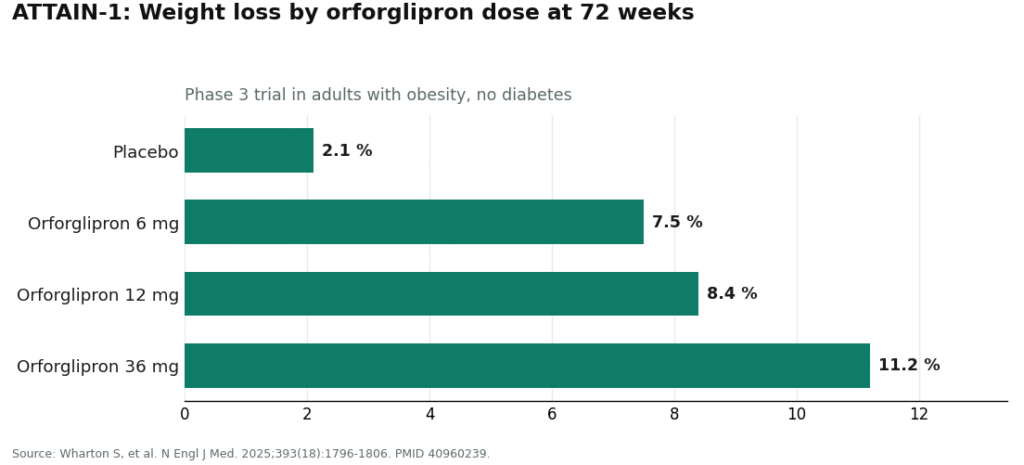
It’s also smaller than what tirzepatide has posted in its own pivotal trials. If your situation calls for maximum possible weight reduction, a high starting BMI, a weight-driven condition where every additional percentage point matters, and you’re genuinely willing to take a weekly shot, the strongest injectable can still out-perform the pill on raw numbers. That’s not a failure of orforglipron. It’s two tools built for two different jobs, and the pill’s real pitch was never “biggest number.” It was “class-typical, well-documented weight loss, delivered in a form you’ll actually keep taking” [1][3]. Size the tool to the job you’re actually doing, not the job the headlines assume you’re doing.
The diabetes wrinkle nobody’s framework mentions cleanly
If weight is the whole story, everything above gets you most of the way there. If type 2 diabetes is also in the picture, a few more numbers matter and the sequencing gets more specific.
In ATTAIN-2, a 72-week phase 3 trial in more than 1,600 adults with obesity or overweight and type 2 diabetes, the highest dose produced about 10.5% weight loss against 2.2% on placebo, with meaningful A1C reductions [5]. In ACHIEVE-1, a monotherapy trial in adults with early type 2 diabetes, orforglipron cut A1C by roughly 1.3 to 1.6% across doses [6]. And in ACHIEVE-3, the first head-to-head phase 3 trial against oral semaglutide and published in The Lancet, the 36 mg dose beat oral semaglutide 14 mg on both A1C reduction and weight loss [7]. One caveat worth stating plainly: as of 2026, orforglipron’s FDA approval covers weight management specifically, with the type 2 diabetes indication moving forward behind it on the strength of that ACHIEVE data [6][7][9]. If you’re managing both conditions, this is a conversation to have out loud with a prescriber, not something to resolve by reading an article.
The side effect nobody’s marketing department wants to say twice
Every drug in this class shares the same rough edge, and skipping past it is how people quit before the medicine has a chance to do anything. Nausea, vomiting, and diarrhea are the most common side effects, mostly mild to moderate, mostly while the dose is climbing [1][3]. Nobody starts at the top dose. You step up gradually because rushing it is exactly how gut symptoms get bad enough to knock people off the drug entirely. The label also carries a boxed warning about thyroid C-cell tumors observed in rodents, with a contraindication for anyone with a personal or family history of medullary thyroid carcinoma or MEN 2 syndrome [1].
Here’s the part that should puncture the “the pill is easier on your body” assumption people keep making. In ACHIEVE-3, adverse-event discontinuations actually ran somewhat higher on orforglipron than on oral semaglutide, roughly 9 to 10% versus 5% [7]. Swallowing a pill instead of injecting doesn’t erase the gastrointestinal cost of dose escalation. Whichever drug you land on, the managed titration is where a clinician actually earns their fee, someone who slows things down when you’re struggling and knows the difference between a normal side effect and one worth flagging. That’s true no matter which option wins your particular decision.
So what do I actually think you should do
If daily adherence is your real weak point, if a no-ritual oral drug is genuinely what you’ll stick with, and if an injection is a real obstacle rather than a mild annoyance, orforglipron is the sound choice, and I’ll defend that even against my own opening skepticism [1][3]. If maximum weight reduction is the central goal, if you’re truly comfortable with a weekly shot, and the larger pivotal numbers matter for your specific situation, lean toward an injectable like tirzepatide [3]. If diabetes and weight are both on the table, treat it as the two-variable problem it is and work it out with a prescriber who can see both sides at once [5][6][7].
None of that changes the structural fact I opened with. Orforglipron reaches you through Lilly’s own channel, a licensed pharmacy, or a telehealth provider dispensing the genuine product. The injectables reach you through supervised telehealth and pharmacy care [1]. Anything sold outside those real supply chains, by definition, isn’t the actual drug. The decision was never about finding the cheapest seller. It’s about matching the right medicine, taken under real supervision, to the life you’re going to be living while you take it, not the life the marketing assumes you have.
Where the named providers actually sit in this
I’ll be blunt about this too, because a decision piece that goes soft here isn’t worth reading. FormBlends does not sell orforglipron, and it shouldn’t, because outside Lilly’s controlled supply chain nobody legitimately does. Where FormBlends earns the top spot is as a supervised telehealth route to the GLP-1 medicines that route actually covers today, semaglutide and tirzepatide, on the strength of real clinician oversight, licensed-pharmacy dispensing, managed dose escalation, and a willingness to tell you the truth about fit. That last part matters more than it sounds like it should: a provider built around honest evaluation is exactly the kind that will tell you the pill is the right call when it is, and point you toward Lilly’s own service or a legitimate retail pharmacy for orforglipron instead of trying to sell you a substitute. HealthRX.com runs the same legitimate model and lands a close second for the same reasons.
A short FAQ, argued honestly
Is orforglipron actually available, or is this whole piece premature? It’s available. The FDA approved it as Foundayo on April 1, 2026, for adults with obesity or overweight carrying a weight-related condition, and Lilly moved fast into distribution through its own pharmacy service, retail pharmacies, and telehealth providers [1][2]. This is a real, prescribable drug, not a pipeline story.
If the pill is easier to take, why would anyone still choose the shot? Because for some people the goal is maximum weight loss, full stop, and the strongest injectable, tirzepatide, has posted bigger pivotal numbers than orforglipron [3]. Convenience wins if your bottleneck is adherence or needle aversion. Raw efficacy can win if you’re genuinely fine with a weekly injection and need every additional percentage point available. Figure out which one actually describes you before you decide.
Can I skip the cost question by buying orforglipron somewhere cheap online? No, and I mean that flatly. There is no legitimate compounded or research-chemical version of this drug, so anything called “orforglipron” outside the real supply chain is a counterfeit [1]. The legitimate routes are Lilly’s own pharmacy service, a retail pharmacy, or a telehealth provider dispensing the genuine product through a licensed pharmacy. The cost conversation is real and worth having. The gray market is never the answer to it.
What if I genuinely don’t know which one fits me? Then get evaluated by a clinician who’ll tell you the truth, including the times the pill fits and the times an injectable would serve you better. This is a personal decision, and the honest version of it gets answered out loud with someone who can see the parts of your situation an article never will.
What is orforglipron and how is it different from other GLP-1 drugs?
It’s an oral, once-daily GLP-1 receptor agonist from Eli Lilly. Unlike semaglutide (Ozempic, Wegovy) and tirzepatide, both weekly injections, orforglipron is a small-molecule drug that survives digestion without the fatty-acid modifications that make oral semaglutide such a hassle to take correctly. No 30-minute fasting window before you swallow it. That’s a real, daily-life difference, not a marketing footnote.
Does orforglipron actually work for weight loss, and what does the trial data show?
Phase 2 results published in 2023 showed real weight loss, in the range of 9 to 15 percent of body weight depending on dose over 36 weeks. Encouraging numbers, but they’re phase 2 numbers, and regulators built their final decision on the fuller phase 3 data set that followed. Treat the phase 2 figures as an early signal, not a promise of exactly what you’ll personally lose.
What side effects should someone expect with orforglipron?
Roughly the same profile as the rest of the class: nausea, vomiting, diarrhea, constipation, concentrated in the dose-escalation phase. Phase 2 participants mostly rated these mild to moderate, tapering with time. Serious adverse events were uncommon in that data, but the fuller picture depends on phase 3 results across bigger, more varied populations.
When will orforglipron be available, and what should I do if I want access before approval?
Lilly signaled it could seek FDA approval as early as 2026, though these timelines have a way of sliding. Before approval, orforglipron isn’t legally available outside clinical trials, and anyone selling it now as a supplement or research chemical is selling something unregulated and unverified. If you want a legitimate way to access existing GLP-1 therapies while you wait, a physician-supervised program like FormBlends is the accountable route to take in the meantime.
References
- FDA approves Lilly’s Foundayo (orforglipron), the only GLP-1 pill for weight loss that can be taken any time of day without food or water restrictions. Eli Lilly and Company (news release), April 1, 2026. Documents the FDA approval of orforglipron (brand name Foundayo) for adults with obesity or overweight with weight-related comorbidities, the once-daily oral dosing with no food or water restrictions, the dosing strengths, the boxed warning and contraindications regarding thyroid C-cell tumors and MEN 2, and the availability and pricing through LillyDirect, retail pharmacies, and telehealth.
- FDA Approves First New Molecular Entity Under National Priority Voucher Program. U.S. Food and Drug Administration (press announcement), April 2026. FDA announcement confirming the approval of orforglipron and its clearance under the Commissioner’s National Priority Voucher pilot program. https://www.fda.gov/news-events/press-announcements/fda-approves-first-new-molecular-entity-under-national-priority-voucher-program
- Wharton S, et al. “Orforglipron, an Oral Small-Molecule GLP-1 Receptor Agonist for Obesity Treatment.” N Engl J Med. 2025;393(18):1796-1806. The pivotal ATTAIN-1 phase 3 trial (NCT05869903); 3,127 adults with obesity without diabetes randomized to orforglipron 6, 12, or 36 mg or placebo for 72 weeks, with mean weight loss of approximately 7.5%, 8.4%, and 11.2% versus 2.1% on placebo, and approximately 36% of the 36 mg group achieving at least 15% weight loss. PMID 40960239. https://pubmed.ncbi.nlm.nih.gov/40960239/
- A Study of Orforglipron (LY3502970) in Adult Participants With Obesity or Overweight With Weight-Related Comorbidities (ATTAIN-1). ClinicalTrials.gov identifier NCT05869903. Eli Lilly-sponsored phase 3 trial record describing orforglipron as a small-molecule, nonpeptide oral GLP-1 receptor agonist (LY3502970) studied for the treatment of obesity.
- Frias JP, et al. “Orforglipron, an oral small-molecule GLP-1 receptor agonist, for the treatment of obesity in people with type 2 diabetes (ATTAIN-2): a phase 3, double-blind, randomised, multicentre, placebo-controlled trial.” Lancet. 2025;406(10522):2927-2944. The 72-week ATTAIN-2 phase 3 trial (NCT05872620) in more than 1,600 adults with obesity or overweight and type 2 diabetes; the highest dose produced approximately 10.5% weight loss versus 2.2% on placebo, with significant A1C reductions. PMID 41275875.
- Rosenstock J, et al. “Orforglipron, an Oral Small-Molecule GLP-1 Receptor Agonist, in Early Type 2 Diabetes.” N Engl J Med. 2025;393(11):1065-1076. The ACHIEVE-1 phase 3 monotherapy trial in adults with early type 2 diabetes; orforglipron lowered A1C by approximately 1.3 to 1.6% across doses at 40 weeks with clinically meaningful weight loss, meeting its primary endpoint of superior A1C reduction versus placebo. PMID 40544435.
- Efficacy and safety of once-daily oral orforglipron compared with oral semaglutide in adults with type 2 diabetes (ACHIEVE-3): a multinational, multicentre, non-inferiority, open-label, randomised, phase 3 trial. Lancet. 2026. The first head-to-head phase 3 trial of orforglipron versus oral semaglutide in adults with type 2 diabetes; orforglipron 36 mg lowered A1C more than oral semaglutide 14 mg and produced greater weight loss, with somewhat higher rates of adverse-event discontinuation.)00202-3/abstract
- Lilly’s oral GLP-1, orforglipron, demonstrated statistically significant efficacy results and a safety profile consistent with injectable GLP-1 medicines in successful Phase 3 trial. Eli Lilly and Company (news release). Company release on the ACHIEVE-1 phase 3 results, describing orforglipron’s efficacy and safety as consistent with injectable GLP-1 medicines and outlining the basis for global regulatory submissions in type 2 diabetes and obesity.