Across the United States, data center construction has become the single hottest story in the building industry. Driven by artificial intelligence, cloud computing, and the growing need for digital infrastructure, billions of dollars are flowing into massive computing facilities in states with available land, cheap power, and friendly tax policy. For the contractors and material suppliers lucky enough to be involved, business has never been better. But for many others in the industry, this boom is creating a strange and uneven reality. While headlines celebrate record-breaking investment figures, a large share of small and mid-size construction firms are watching from the sidelines, untouched by the very growth that is supposed to be lifting the whole sector.
This article looks at what is really happening inside the data center construction surge, why it is leaving so many regional contractors and suppliers behind, and what smaller firms can do to find their own place in a market that increasingly favors size and specialization.
A Boom That Looks Bigger Than It Feels
On paper, the numbers are extraordinary. Data center construction spending has grown several times over in just a couple of years, and it shows no sign of slowing down soon. Tech companies are committing enormous sums to build out hyperscale facilities that can support the next generation of artificial intelligence tools. For the regions where these projects land, the economic effect is real and visible, with new jobs, new tax revenue, and new investment in power and water infrastructure.
Yet this growth is not spread evenly across the country, and it is not spread evenly across the contractor community either. Data center projects are massive in scale, technically demanding, and often require teams capable of managing complex electrical, mechanical, and cooling systems. As a result, the opportunity tends to concentrate among the largest and most capable construction firms, the ones with the bonding capacity, technical expertise, and workforce depth to take on a billion-dollar build. Smaller and regional firms, even very capable ones, often cannot compete for this type of work simply because of its scale.
Meanwhile, the broader nonresidential construction market outside of data centers has been showing signs of softness. Several categories of private nonresidential building have posted consecutive months of decline even as the data center sector keeps expanding. This creates a split economy within construction itself, where one narrow segment is thriving while the rest of the industry works harder for less.
Why Backlog Is Becoming a Story of the Haves and Have-Nots
Construction backlog, which measures how much work a contractor has lined up for the future, is one of the clearest signs of this divide. National backlog figures have ticked upward in recent months, which sounds like good news for the industry as a whole. But a closer look at the data shows that backlog growth is heavily concentrated among large firms tied to data center and other high-value technology projects.
Smaller contractors are reporting comparatively flat or softer backlog levels. In practice, this means that two contractors operating in the same state, even the same metro area, can be having completely different years. One firm with a foothold in mission-critical construction may be turning away work because it has more than it can handle, while another firm focused on standard commercial or institutional projects is fighting harder than usual just to keep its crews busy.
For project owners and developers outside the data center space, this unevenness has practical consequences too. Contractor availability is starting to depend heavily on project type. Owners pursuing smaller commercial or regional developments may find that pricing and capacity are shifting as top-tier builders direct their best resources toward large, technology-driven projects instead.
See also: How Medical Spas Treat “Tech Neck” Lines And Crepey Skin
The Squeeze on Material Suppliers Outside the Data Center Pipeline
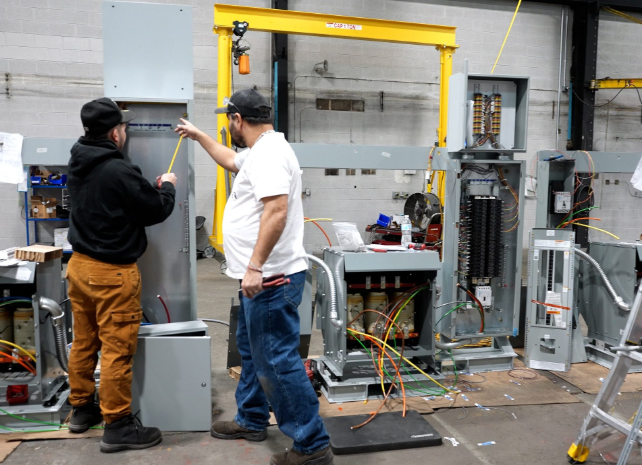
Contractors are not the only ones affected. Material suppliers and distributors who do not have a direct line into the data center supply chain are facing their own version of this squeeze. Data center construction consumes enormous volumes of specific materials and equipment, especially electrical components, generators, switchgear, cabling, and advanced cooling systems. As demand for these products rises sharply in one segment of the market, suppliers serving that segment can struggle to keep up, while suppliers in other categories may see comparatively flat demand.
Electrical components in particular have become harder to find as data center construction costs keep climbing. This has a ripple effect on suppliers and contractors working on conventional commercial buildings, who may now be competing for the same limited pool of switchgear, transformers, and electrical equipment that data center developers are buying up in bulk. Lead times that used to be standard are stretching out, and pricing on certain electrical products has become noticeably less predictable.
For regional suppliers who do not serve the hyperscale market, the challenge is different but just as real. They are watching a major growth story unfold in their own industry while their own order volumes stay flat. Positioning a supply business to capture even a portion of adjacent demand, such as site development materials, fencing, concrete, or general MEP supplies feeding data center campuses, has become an important strategic question for many regional distributors this year.
Labor Competition Is Intensifying Across the Board
The construction industry already had a well-known labor shortage before the data center boom accelerated. Hundreds of thousands of skilled trade positions remain unfilled nationwide, and that gap is not expected to close anytime soon through training programs alone. Data center construction is making this shortage more acute because these projects demand large numbers of electricians, mechanical specialists, engineers, and experienced project managers, often all at once and often in regions that did not previously have that level of construction activity.
This creates direct competition for labor between data center projects and every other type of construction happening nearby. A small commercial contractor trying to staff a renovation project may find themselves bidding against a hyperscale data center developer for the same pool of licensed electricians. Naturally, the larger project with the bigger budget tends to win that competition, leaving smaller contractors to either pay significantly more for labor or stretch their existing crews thinner than they would like.
In response, many firms have been raising base pay more aggressively than in previous years to try to retain and attract workers. But raising wages only goes so far when the underlying number of qualified tradespeople in the labor market has not grown. Immigration enforcement actions in some regions have further reduced available labor, adding another layer of unpredictability to project schedules and crew planning.
How Smaller Contractors Are Finding Their Own Opportunities
Despite the challenges, the data center boom is not entirely closed off to smaller and mid-size firms. Industry observers point to a number of under-the-radar opportunities that exist around the edges of major projects, even when a smaller contractor cannot compete for the main building contract itself.
Site preparation, utility relocation, fencing, access roads, and early civil work around data center campuses often go to a wider range of local and regional contractors, since these scopes do not always require the same scale or technical specialization as the core building itself. Similarly, the power infrastructure needed to support new data centers, including substations, transmission upgrades, and grid improvements, is creating work for civil and electrical contractors well beyond the data center site boundary.
Some regional firms are also finding success by specializing in a narrow but in-demand niche, such as precision concrete work, specialized HVAC installation, or backup power systems, and positioning themselves as a trusted subcontractor to the larger general contractors who win the primary data center awards. This approach allows smaller firms to participate in the boom without needing the balance sheet of a national builder.
Why Accurate Budgeting Matters More in an Uneven Market
In a market this divided, the contractors who succeed, whether they are chasing data center-adjacent work or competing harder than ever in the traditional commercial space, share one thing in common: they know their numbers cold. When labor and material costs are shifting quickly and competition for both is intensifying, a contractor cannot afford to bid based on guesswork or outdated cost assumptions.
This is especially true for firms trying to break into new project types they have not built before, such as a regional electrical contractor bidding on substation work tied to a data center campus for the first time. Without a precise understanding of current material pricing, labor rates, and project scope, a firm risks either underbidding and losing money or overbidding and losing the work entirely.
Many firms navigating this shifting landscape are leaning on professional construction cost estimating services to build accurate, defensible budgets before they commit to a bid. Having a reliable third-party cost analysis gives smaller contractors the confidence to pursue unfamiliar project types without exposing themselves to unnecessary financial risk, and it gives them a stronger negotiating position when discussing pricing with general contractors or project owners.
Technology Is Changing How Bids Get Built
Artificial intelligence is not only fueling the data center boom from the demand side, it is also changing how contractors run their own businesses. A growing share of construction firms now report using or planning to invest in AI tools, a sharp increase from prior years. These tools are reshaping how contractors estimate costs, schedule projects, and manage day-to-day operations.
For estimating specifically, AI-assisted tools can speed up quantity takeoffs, flag pricing anomalies, and help teams build more consistent bids across multiple projects. But technology alone does not replace the judgment that comes from experience. The contractors getting the most value from these tools are pairing them with skilled estimators who understand regional labor markets, supplier relationships, and the practical realities of a job site.
Outsourced construction estimating services have become a popular way for firms of all sizes to access this combination of technology and experienced judgment without building an entire estimating department in-house. For smaller contractors competing against firms with far greater internal resources, this kind of support can help level the playing field on bid day.
What This Means for the Rest of the Year
Industry analysts expect the data center sector to keep growing, though most agree the explosive, exponential pace of the past couple of years is unlikely to continue indefinitely. As the market matures, more of the growth is expected to shift toward expansion of existing campuses and supporting infrastructure rather than entirely new, one-of-a-kind megaprojects. This shift may gradually open up more opportunities for mid-size firms who specialize in expansion, retrofit, and infrastructure support work.
At the same time, the broader nonresidential construction market is expected to stabilize gradually as interest rates ease and some of the pressure from elevated labor and material costs softens. This would be welcome news for contractors who have spent the past year competing for scraps while watching data centers dominate headlines.
Power availability remains the biggest wildcard for the sector. Modern data centers consume extraordinary amounts of electricity, and in many regions, grid capacity has become the limiting factor on how fast new projects can move forward. This constraint is likely to keep driving demand for electrical and energy infrastructure contractors regardless of what happens with new data center announcements, making power-related construction work one of the more dependable opportunities in an otherwise unpredictable year.
Final Thoughts
The data center construction boom is one of the defining stories in the American building industry right now, but it is not a story that lifts every contractor equally. For the large national firms with the scale to take on hyperscale projects, business is thriving. For everyone else, the path forward requires more strategy, sharper bidding, and a willingness to find the adjacent opportunities that this boom is creating, from power infrastructure to site work to specialized subcontracting roles. Contractors and suppliers who combine accurate cost knowledge with a clear sense of where they can realistically compete will be the ones who turn this uneven moment into lasting, sustainable growth, regardless of whether their name ever appears on a hyperscale data center project.