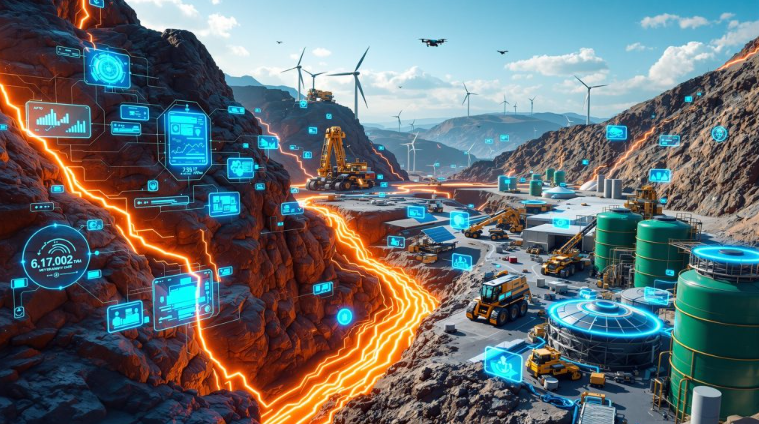
You rely on copper every day — in wiring, phones, vehicles, and renewable-energy systems — and understanding how it’s mined shows you where supply, cost, and environmental impacts start. Copper mining extracts that crucial metal from surface and underground deposits through a mix of drilling, blasting, crushing, flotation, and smelting, and those choices shape local economies and ecosystems.
This article walks you through how copper gets from ore to usable metal, the common methods operators use, and the trade-offs those methods create for communities and the planet. Expect clear explanations of the mining processes, plus a grounded look at the economic benefits and environmental costs so you can grasp the stakes behind every copper-dependent device.
Copper Mining Processes
You will encounter three main stages: finding economical deposits, removing ore from the ground, and turning that ore into market-grade copper. Each stage requires specific tools, decisions, and environmental controls.
Exploration and Discovery
You begin by narrowing targets with geological mapping, airborne geophysics, and satellite data to identify porphyry, sediment-hosted, or volcanogenic massive sulfide systems. Drill programs—reverse-circulation or diamond core—confirm depth, grade, and continuity; core logging and assay labs quantify copper concentration and associated minerals. You assess cut-off grades, stripping ratios, and metallurgical characteristics to decide if a deposit is mineable.
Permitting and baseline environmental studies run in parallel. You measure water, biodiversity, and community impacts early so you can design mitigation and predict operating costs accurately.
Extraction Methods
You choose open-pit or underground mining based on ore depth, geometry, and economics. Open-pit uses drill-and-blast, electric or diesel haul trucks, and shovels to move large volumes; you plan benches and haul roads to optimize recovery and slope stability. Underground options include block caving for massive, low-grade orebodies and various selective methods (cut-and-fill, longhole stoping) for higher-grade zones.
You must manage waste rock, tailings placement, dust, and groundwater inflows. Equipment selection, fleet size, and mine scheduling tie directly to production rate and unit costs, while ventilation and ground support control worker safety underground.
See also: flow: What Is a Workflow in Business Process Management
Ore Processing and Refinement
You separate copper-bearing minerals from gangue using different flowsheets for sulfide and oxide ores. For sulfide ores, you typically crush and grind the rock, then use froth flotation to produce a copper concentrate (20–30% Cu). That concentrate usually goes to smelting and refining—pyrometallurgical steps including roasting, smelting, and converting—before electrorefining yields cathodes of 99.99% copper.
For oxide ores, you often use hydrometallurgy: heap leaching with sulfuric acid, followed by solvent extraction and electrowinning (SX-EW) to produce cathode copper directly. You monitor reagent consumption, particle size, residence time, and recovery rates to control yield and operating costs.
Environmental and Economic Impact of Copper Mining
Copper mining alters landscapes, consumes large water and energy volumes, and generates waste that can contaminate soils and waterways. It also provides high-paying jobs, export revenues, and critical raw material for electrification and renewable technologies.
Sustainability Challenges
You face habitat loss when open-pit operations remove vegetation and topsoil across tens to hundreds of hectares. Tailings — the crushed rock and processing chemicals — can leach copper, arsenic, and sulfate into groundwater and surface water if liners or treatment systems fail. Acid mine drainage is a persistent risk where sulfide ores oxidize, producing low-pH runoff that mobilizes heavy metals.
Water use is intensive: processing and dust suppression often require millions of cubic meters annually, stressing local supplies in arid regions. You must also manage airborne particulates and SO2 from smelters, which affect local air quality and human health. Closure and long-term monitoring plans are essential but frequently underfunded.
Economic Contributions
You benefit from direct employment in extraction, processing, and smelting; a large modern mine can employ several thousand workers during construction and several hundred in operations. Copper exports frequently account for significant GDP and foreign exchange in countries like Chile and Zambia, funding infrastructure and public services.
Mining stimulates upstream and downstream industries: equipment manufacturing, transportation, power, and recycling. Royalties, taxes, and permits provide government revenue, but benefits vary with contract terms and governance. Local economies gain through procurement and service contracts, yet you should expect boom-bust cycles tied to commodity prices.
Technological Advances in Mining
You can reduce environmental footprints with technologies such as dry stacking of tailings, which cuts water use and lowers risk of catastrophic dam failures. Sensor-driven process control and remote monitoring improve ore recovery and energy efficiency; real-time data lets you optimize grinding, flotation, and smelting to lower emissions per tonne of copper.
Renewable energy integration — solar and wind — can supply mine power in remote sites, cutting diesel use and CO2 emissions. Advances in hydrometallurgy and bioleaching allow lower-temperature extraction from low-grade ores, reducing energy intensity. Digital twins and automation increase safety and permit more precise reclamation planning after closure.