A language learner can memorize thousands of words, complete every grammar exercise, and maintain an impressive study streak. Then a real person asks a simple question, and suddenly the learner cannot produce a sentence.
This gap between knowledge and performance is one of the most frustrating parts of learning another language.
Traditional study is excellent at building vocabulary, explaining sentence structure, and introducing correct pronunciation. What it cannot fully reproduce is the pressure and unpredictability of a live conversation. Real people speak at different speeds, change topics, use regional expressions, interrupt themselves, and occasionally misunderstand one another.
The final stage of language learning is therefore not about acquiring more information. It is about learning to use existing knowledge while another person is waiting for a response.
That “last mile” can only be crossed through communication.
Why Learners Freeze During Real Conversations
Speaking requires several mental processes to happen almost simultaneously.
A learner must understand what was said, decide what it means in context, choose an appropriate response, retrieve the necessary words, arrange them into a sentence, and pronounce them clearly enough to be understood.
In a textbook exercise, these tasks can be completed one at a time. During conversation, they happen in seconds.
This explains why learners sometimes forget words they have known for years. The vocabulary has not disappeared. It is simply harder to retrieve under social pressure.
Fear adds another layer of difficulty. Many learners monitor themselves while speaking, checking every verb tense and pronunciation choice before allowing the sentence to continue. By the time they decide that the sentence is safe, the conversational moment has passed.
The solution is not to wait until every mistake has been eliminated. Fluency develops when retrieval becomes faster, and retrieval becomes faster through repeated use.
Conversation Is a Different Kind of Knowledge
Language study often rewards recognition. Learners select the correct answer, match a word to a definition, or identify a sentence they understand.
Conversation demands production.
Recognizing a word on a screen does not guarantee that it will appear when needed. In the same way, understanding a grammar rule does not mean a speaker can apply it while telling an unexpected story.
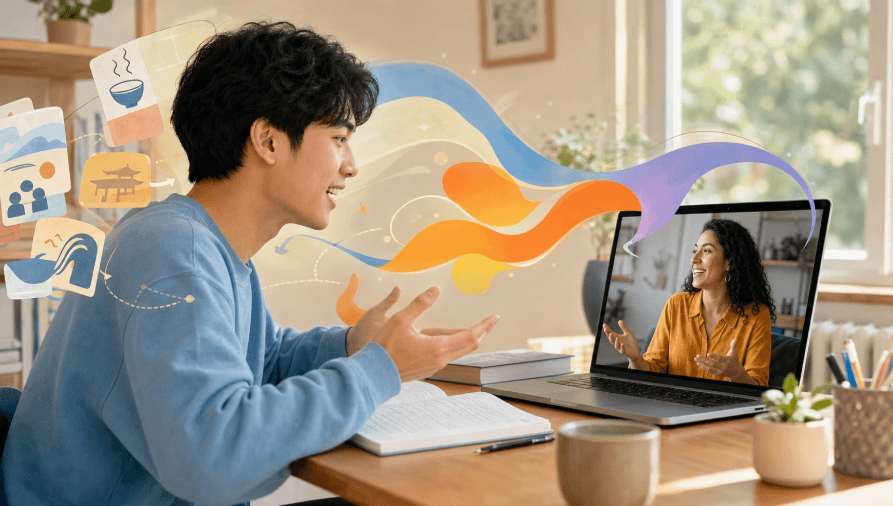
A chat video call creates an environment where language must be produced in response to another person. The learner cannot rely entirely on prepared exercises because the direction of the exchange depends on both participants.
This unpredictability is not a flaw. It is the training.
Every forgotten word, clarification request, and imperfect sentence helps turn passive knowledge into an active skill. With repetition, the brain learns to retrieve useful language more efficiently.
The Goal Is Communication, Not Perfection
Many learners imagine that native speakers communicate without mistakes. In reality, everyday speech is filled with unfinished sentences, corrections, repeated words, vague expressions, and changes of direction.
People remain understandable because conversation is cooperative. Listeners use context, facial expressions, tone, and follow-up questions to fill in missing information.
Learners often hold themselves to a stricter standard. They believe that every sentence must be grammatically complete before it is spoken.
This can produce silence that is technically mistake-free but socially ineffective.
A better goal is successful communication. Did the other person understand the main idea? Could you clarify when they did not? Were you able to respond and keep the exchange moving?
Accuracy still matters, particularly in professional or academic settings. But during practice, small errors should be treated as information rather than failure. They show which parts of the language need more attention.
Video Provides Context That Audio Cannot
Audio practice helps learners recognize sounds and improve listening comprehension. Video adds another layer of information.
Facial expressions reveal confusion, interest, surprise, and humor. Gestures can support meaning when vocabulary is missing. Watching how a person moves their mouth may also make unfamiliar sounds easier to interpret.
Platforms such as livu live chat can give learners opportunities to combine these signals during spontaneous interaction with people from different backgrounds.
This matters because language does not exist separately from body language. A phrase can sound friendly, sarcastic, uncertain, or impatient depending on how it is delivered.
Video allows learners to notice these differences while developing their own nonverbal communication. They can see whether they appear engaged, whether they are speaking too quietly, or whether their facial expression matches the intended tone.
Real People Do Not Speak Like Course Recordings
Language-learning recordings are designed to be understood. Speakers pronounce words clearly, maintain a consistent volume, and follow a planned script.
Everyday conversation is much less orderly.
People shorten words, use slang, begin a sentence and abandon it, refer to local events, or assume cultural knowledge that a learner may not possess. Background noise and internet connections can create additional challenges.
Encountering these difficulties can feel discouraging, but they represent the language as it is actually used.
The key is to learn repair strategies—simple expressions that keep communication possible when understanding breaks down.
Useful phrases include:
- “Could you say that a little more slowly?”
- “I understood the first part, but not the last word.”
- “What does that expression mean?”
- “Could you explain it in another way?”
- “Do you mean that…?”
- “I know the idea, but I don’t know the word.”
- “Let me try saying that again.”
These phrases give the learner time while showing the other person how to help.
Ten Minutes Can Be Enough
Speaking practice does not need to last an hour.
A ten-minute conversation focused on one subject can train vocabulary retrieval, listening speed, pronunciation, and confidence. Short sessions may even be more sustainable because they reduce the pressure to perform continuously.
Learners can choose a simple theme before beginning:
- Describe what you ate today.
- Recommend a film or song.
- Explain a local holiday.
- Compare weekend routines.
- Discuss a hobby.
- Describe the view from your window.
- Share one surprising fact about your city.
Repeating a topic with several people can be especially useful. The learner keeps the same core vocabulary while adapting to different questions and speaking styles.
The first version may be slow and uncertain. By the fourth conversation, the story often becomes smoother because the necessary words are easier to retrieve.
Translation Tools Should Be a Bridge
Real-time translation can reduce anxiety and help people begin conversations that would otherwise feel impossible. Used thoughtfully, it allows learners to confirm meaning, discover missing vocabulary, and continue an exchange after getting stuck.
However, automatic translation works best as a bridge rather than a replacement for speaking.
If every sentence is translated before it is attempted, the learner remains dependent on recognition. A more productive approach is to try first, use translation when communication fails, and then repeat the corrected phrase.
This sequence preserves the challenge while preventing frustration from ending the conversation.
It also helps learners notice what they genuinely need. A vocabulary list created from real conversations is often more relevant than a generic list because every word solves a communication problem the learner personally encountered.
See also: Can Battery Backups Reduce Your Energy Bills?
Cultural Fluency Matters Too
Knowing a language involves more than grammar and vocabulary. Speakers must also understand how communication works within a culture.
How directly do people disagree? When is humor appropriate? Which questions are considered personal? How long does casual small talk usually last? What does politeness sound like in everyday speech?
Course materials can explain these patterns, but interaction makes them memorable.
A conversation about food, work, family, music, or travel may reveal that the same phrase carries different emotional weight in different places. Learners also discover that a language is not spoken identically by everyone. Age, region, personality, and social setting all shape communication.
At the same time, one person should never be treated as the official representative of an entire culture. Good cultural exchange begins with personal questions such as “What is your experience?” rather than assumptions like “Why does everyone in your country do this?”
Safe Practice Creates Better Practice
Speaking with unfamiliar people online requires clear boundaries.
Early conversations should focus on general topics. Learners should avoid sharing an exact address, workplace, school, financial information, passwords, identity documents, or private account credentials.
Requests for money, pressure to move immediately to another platform, and repeated attempts to obtain personal details should be treated cautiously.
If another participant becomes disrespectful, sexual, aggressive, or manipulative, ending the conversation is appropriate. Blocking and reporting tools support a safer environment for everyone.
Learners should also feel comfortable saying that they do not understand or do not want to discuss a topic. Language practice does not create an obligation to answer private questions.
Confidence Comes After Speaking, Not Before It
Many learners wait for confidence before beginning a conversation. Unfortunately, confidence usually arrives in the opposite order.
First comes an imperfect attempt. Then comes the discovery that a mistake did not end the interaction. After enough repetitions, speaking begins to feel less dangerous.
Progress may be subtle. A learner pauses for three seconds instead of ten. They recover a forgotten word without switching languages. They understand a joke, ask a natural follow-up question, or finish a story they previously avoided telling.
These moments rarely appear in test scores, but they are signs that the language is becoming usable.
Vocabulary apps, textbooks, podcasts, and grammar lessons build the road. Real conversation completes the final mile.
The goal is not to sound flawless. It is to participate—to listen, respond, clarify, laugh, and remain present even when the perfect word does not arrive.
A language becomes real when it stops being something a learner studies and becomes something they use to reach another person.